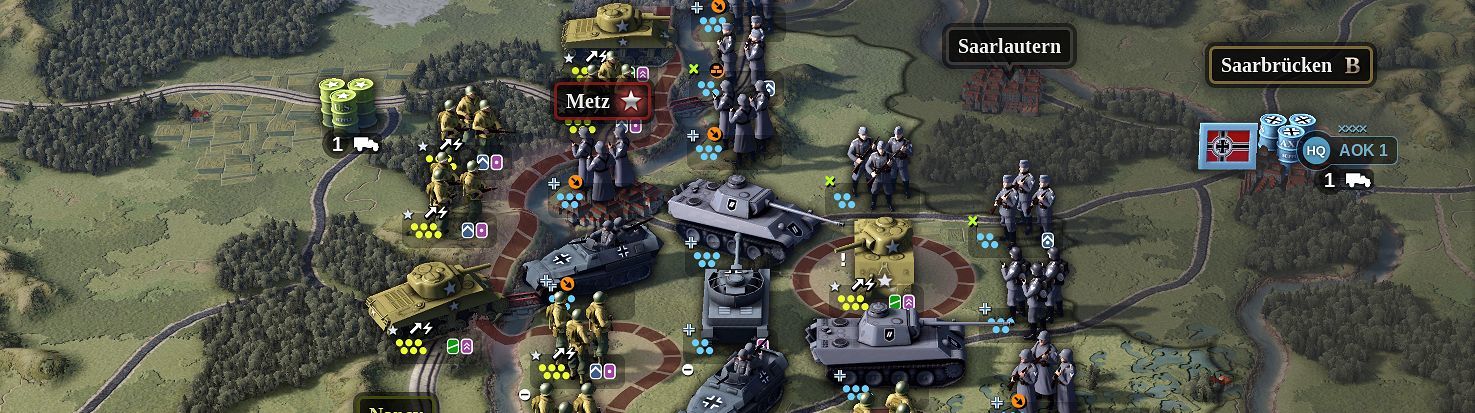
 [b]November 1944.[/b] The city of Metz, located near the German border, still stands in the way of Allied push across France towards the heart of the Third Reich.
Patton’s Third Army had been fighting fiercely since early September to dislodge the Germans from the heavily fortified city, suffering casualties that approached 50%. Hitler had ordered that the city, and the fortress complex around it, were to “hold at all costs”.
Metz did hold. It was one of the greatest shows of resistance by the Third Reich in World War II.
[b]November 1944.[/b] The city of Metz, located near the German border, still stands in the way of Allied push across France towards the heart of the Third Reich.
Patton’s Third Army had been fighting fiercely since early September to dislodge the Germans from the heavily fortified city, suffering casualties that approached 50%. Hitler had ordered that the city, and the fortress complex around it, were to “hold at all costs”.
Metz did hold. It was one of the greatest shows of resistance by the Third Reich in World War II.
Eyes on the Sky
That is, of course, until December when the last of the city’s defenders were forced to surrender. To help put things into perspective, Americans had more than 3.500 fighter planes and even more bombers available. Together with the Royal Air Force, the combined Allied air strength on the Western Front was almost 14.000 planes. Luftflotte 3, protecting the German armies on the Western Front, had less than 600 available aircraft. It’s safe to say that Allied air forces held overwhelming superiority over the Luftwaffe in western Europe. German commanders pleaded with Hitler to allocate at least 700 more planes to the area. There was even talk of Luftwaffe’s secret weapon, one so powerful that it could turn the tide of war: world’s first operational jet fighter! Messerschmitt 262 jets were real and deadly, but in reality jets were barely operational by the time the Battle of Metz took place and were too few in numbers to make a difference. The rest of the requested planes never arrived. Even with clear air superiority, the Third Army was still bogged down in the mud, unable to advance. There were several reasons for this:- P–47’s carried 500-pound bombs that had little effect on reinforced concrete and bunkers around Metz
- Tactical Air Command that supported the Third Army was too dispersed (flying both Metz and Brest, almost 800 kilometers apart)
- Metz would open up a route to Frankfurt and Saar, and the Saar route was a lower priority compared to the lower Rhine and the Ruhr. Ruhr>Saar.
- Finally, and most importantly - the bad weather