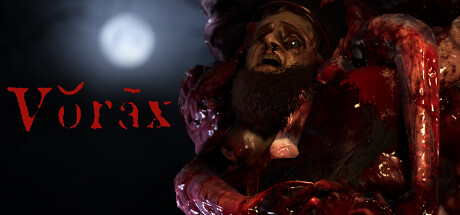
Hi everyone, I want to share a clear update on the future of [b]Vorax[/b] and explain what [i]Rebirth[/i] really means.
This is not a marketing post. It’s an explanation.
First, one important thing:
[b]Vorax has never failed in what it wanted to be artistically.[/b] Its atmosphere, visual identity, creature design and overall tone have always been the part I was most proud of — and many of you appreciated those aspects too.
Where Vorax truly struggled was [b]on the technical side[/b]: stability, performance, and the ability to evolve cleanly over time.
How Vorax ended up in this state
During most of Vorax’s development (almost three years), I was heavily involved in a demanding real-world project — a large-scale company building renovation that absorbed a huge amount of my time and energy throughout 2022–2024.
While that project ultimately ended successfully, it [b]took away the developer focus[/b] that Vorax needed.
Because of this, I delegated most of the technical and architectural decisions of Vorax. That choice, combined with the complexity of a true open-world structure, led to a codebase that was difficult to optimize, difficult to extend, and increasingly fragile.
This is [b]not an attempt to shift responsibility[/b]. The responsibility for Vorax — its strengths [i]and[/i] its failures — is [b]entirely mine[/b].
I created the project, I supervised it (poorly, at times), and the final result is on me.
The turning point (2025)
In 2025, once the real eastate project was finally over, I was able to look at Vorax with fresh eyes and full focus.
What I found was clear and unavoidable:
multiple architectural bottlenecks
technical choices that made iteration slow and risky
performance issues deeply rooted in the core structure
At that point, continuing to “patch” Vorax would have been dishonest and ineffective.
So I made a hard decision:
[b]stop everything, analyze everything, and start over.[/b]
This also meant [b]ending all previous technical collaborations[/b] related to the old implementation. Again: not to blame anyone — but because the architecture itself needed a clean break.
What “Rebirth” means
[b]Vorax: Rebirth[/b] is not a continuation of the old build.
Vorax Rebirth is not Vorax with fixes. It is a [b]restart from version 0.1[/b].
Some key changes:
the previous fully open-world technical approach has been abandoned (this will [i]not[/i] negatively affect the gameplay experience)
the game is now built around [b]contained environments / levels[/b], far more sustainable
I am personally handling the [b]core technical architecture[/b]
performance and stability come [b]before[/b] content and story
Rebirth will start [b]slowly and deliberately[/b].
The first versions will focus on:
sandbox-style environments
core systems (inventory, weapons, enemies, AI, combat)
solid performance and clean behavior
Only [b]after[/b] the technical foundation proves stable and reliable will we expand:
environments
narrative elements
story progression
This is the opposite of how the original Vorax was built — and that is intentional.
The initial versions will be closer to a [b]sandbox environment[/b], where players can experience and test the core systems: inventory, weapons, enemies, movement, combat, survival mechanics — this time implemented properly.
Only [b]after[/b] performance and stability are solid will narrative elements and larger content be added.
[b]Why I’m confident this time[/b]
Today the situation is very different:
my time and focus are finally fully back on development
I’ve spent months deeply understanding what went wrong, both technically and structurally
I’m rebuilding Vorax with a simpler, clearer, and far more realistic architecture
development is once again focused, enjoyable, and technically solid
In parallel, I’ve been working on a smaller project ([i]The Apartment[/i], a working title, to be released in the coming months). That project has been extremely valuable for me as a developer: it allowed me to refine workflows, performance strategies, and architectural decisions that directly apply to Vorax Rebirth.
Several core technical aspects are shared between the two projects, and what I’ve learned there is already shaping Vorax in a much healthier way.
This doesn’t mean promises or deadlines. It means a sustainable path forward.
Looking ahead
Rebirth will grow [b]step by step[/b], update by update. Players who appreciated the spirit of the original Vorax will be able to see its core ideas take shape again — this time on foundations that can actually support them.
This is not about rushing. It’s about doing it right.
Thank you to everyone who stayed, criticized constructively, or simply waited. More updates will follow as Rebirth progresses.
— Riccardo