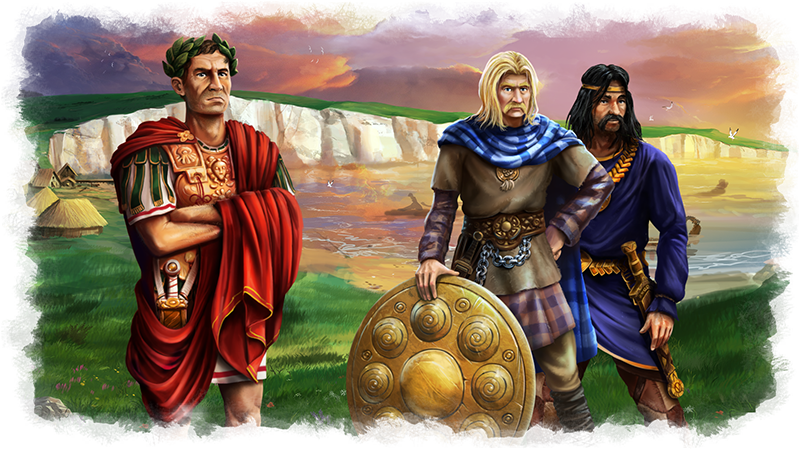
 It was not only Caesar who was a great hero of his time, his opponents, the Gaul Vercingetorix and the Briton Cassivellaunus were just as cunning, powerful and bold.
Caesar led four legions of battle-hardened troops with strong economic support from Rome. The tribes of Gaul and the British Isles had no trained armies of their own, however what they lacked in organization and equipment they made up for with courage and ferocity.
Vercingetorix managed something that no other Gallic leader had achieved, he united all of the Gallic tribes and led them in the most significant rebellion against the Romans. When their attempt failed, he gave himself up to save the lives of his tribesmen. Similarly, Cassivellaunus took the lead to defend his land and people against the Roman invasion and it was only after the defeat of many allied tribes and the devastation of his territories that he surrendered.
There is no doubt that all three of these military commanders were skilled warriors, courageous and bold. Was it the strategic genius of Caesar or the power of the Roman war machine that tipped the balance?
Pavel, our lead game designer, will explain in detail how we incorporated these three great figures into the game.
It was not only Caesar who was a great hero of his time, his opponents, the Gaul Vercingetorix and the Briton Cassivellaunus were just as cunning, powerful and bold.
Caesar led four legions of battle-hardened troops with strong economic support from Rome. The tribes of Gaul and the British Isles had no trained armies of their own, however what they lacked in organization and equipment they made up for with courage and ferocity.
Vercingetorix managed something that no other Gallic leader had achieved, he united all of the Gallic tribes and led them in the most significant rebellion against the Romans. When their attempt failed, he gave himself up to save the lives of his tribesmen. Similarly, Cassivellaunus took the lead to defend his land and people against the Roman invasion and it was only after the defeat of many allied tribes and the devastation of his territories that he surrendered.
There is no doubt that all three of these military commanders were skilled warriors, courageous and bold. Was it the strategic genius of Caesar or the power of the Roman war machine that tipped the balance?
Pavel, our lead game designer, will explain in detail how we incorporated these three great figures into the game.
 [quote=Pavel]The initial plan was to create one unique unit with remarkable abilities that could not be recreated and whose loss would have significant consequences, similar to the Trojan Horse in the [url=https://store.steampowered.com/app/1404250/Imperiums_Troy/][u]Troy DLC[/u][/url].
When we implemented Caesar as a special unit we realized a number of things:
[quote=Pavel]The initial plan was to create one unique unit with remarkable abilities that could not be recreated and whose loss would have significant consequences, similar to the Trojan Horse in the [url=https://store.steampowered.com/app/1404250/Imperiums_Troy/][u]Troy DLC[/u][/url].
When we implemented Caesar as a special unit we realized a number of things:- The unit is a very powerful tool and without a counterpart all opponents are at a big disadvantage.
- It would not be fair to ignore the remarkable abilities of other generals in these conflicts, particularly the Gaul Vercingetorix and the Briton Cassivellaunus.
- The abilities of these units must be implemented very carefully and the AI must use them with great care.
- They should be used in important battles, but their safety must be of top priority, so as to avoid the destructive consequences if they were lost in battle.
- To provide these units with a strategic importance there should be at least two different ways they could be used (just one use would make them very static i.e. just moving them a couple of tiles back and forth along the battlefront).
- Commanders cannot be recruited or hired.
- Once a particular commander is dead, he cannot be recreated. He is lost for good.
- Commanders can encourage units and influence cities similarly to generals but with greater impact.
- Commanders cannot be killed at the player's will.
- Commanders boost the units' morale with their presence on the battlefield.
- Commanders will not rebel or desert.
- When they spend a turn in their capital, it brings more influence to the owner (the commander is lobbying at his court).