Truly Distinct Characters
If you read the [b][url=https://store.steampowered.com/news/app/2432860/view/686362177252098784?l=english]last dev diary[/url][/b] about the perk tree rework, you already saw that we want to make sure all characters are not only different in personality and looks but also offer different playstyles and upgrade paths, ensuring maximum variety and replayability throughout the game. It also makes sense from a lore perspective, as some characters are trained and experienced soldiers or mercenaries, while others might come from rank-and-file troops or even lack any actual military training. Stats in this case are combat-relevant values: Action Points, Discipline, Hitpoints, and Accuracy. We quickly realized that just giving them different stats and calling it a day would not work. First of all, these are not enough to properly differentiate characters. With around 26 characters planned in total, swapping around four stats would simply not cut it, so we had to create more values we can leverage to make the characters actually different. In true RPG fashion, we took a step back and added a whole bunch of attributes for each character:Attributes
[hr][/hr] Like many other RPGs, we decided to go the classical route and have each character have a set of attributes from which the combat stats are then derived. To ensure players can understand differences between characters more easily, all of these Attributes are leveled to 100, meaning that the minimum is 0 and the maximum is 100.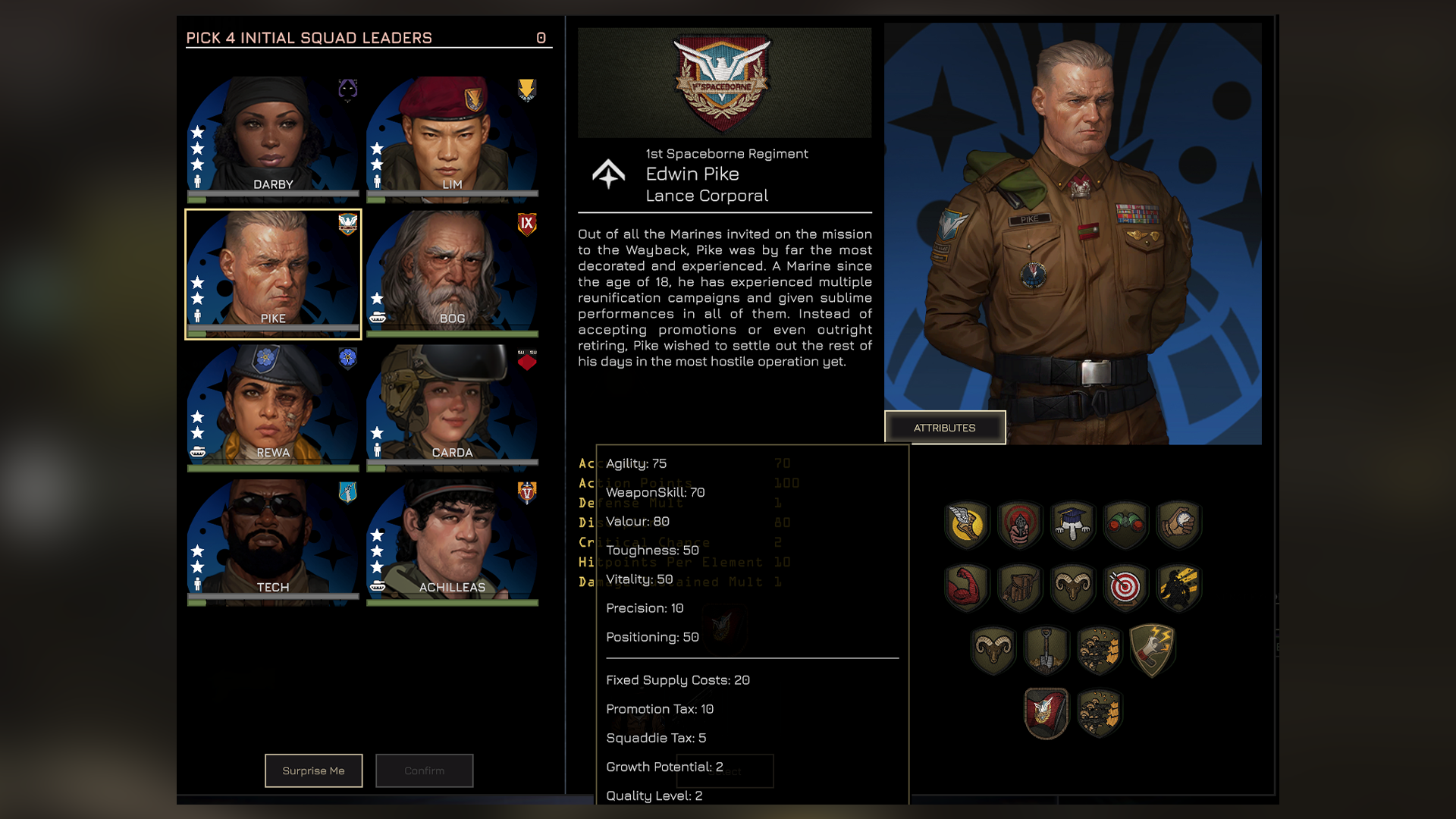 Each of these attributes has a different way of influencing its corresponding stat. Let's take a detailed look at what we have:
[b]Agility -> Action Points[/b]
This is the general agility, quickness, and dexterity of a character, determining how fast and efficiently they can act on the battlefield. The maximum agility of 100 translates into 120 action points. Most characters will start with 75, which gives them 100AP as before.
The decision to pursue different action points for characters was not an easy one, as anything that messes with the action point economy can easily destabilize the game. For example, in BB, we avoided messing with AP as much as possible.
Through playtesting, we are certain that in MENACE, we can get away with it much better and that it will actually add a lot to the game.
[b]Weapon Skill -> Accuracy[/b]
Weapon skill is the level of proficiency with any kind of weapon and how effectively it can be used against an enemy. Weapon Skill gives the characters accuracy. This attribute provides the corresponding stat 1:1, so 70 Weapon Skill equals 70 Accuracy.
[b]Valour -> Discipline[/b]
Valour is a character's overall determination and audacity, and their ability to withstand any type of physical or mental challenge. It translates 1:1 to the Discipline stat.
[b]Toughness -> Damage Reduction[/b]
Some characters are exceptionally resilient to any kind of injury and are phased less by injuries than others. The Toughness attribute translates into damage reduction applied to any damage received. Most characters start with a toughness of 50, which means they have no damage reduction. The maximum toughness of 100 translates to 50% damage reduction. However, certain characters that are more fragile than others might start with a value below 50, meaning they take extra damage from attacks.
[b]Vitality -> Hitpoints per Element[/b]
Vitality describes the general physical constitution of a character and their squad. How fast they gas out, how much blood loss they can take, and how fast or slow they are incapacitated on the battlefield. Vitality determines the hitpoints of each element in a squad. The standard here is 50, which gives 10 hitpoints, while the maximum is 100, which offers 20 hitpoints per element. As with vitality, there are also characters with lower Vitality, meaning the elements in their squad will have less than 10 hitpoints.
[b]Precision -> Critical Hit Chance[/b]
This gives the chance for each attack to score a critical hit, increasing the damage done by 50%. Most characters who are not explicitly trained in marksmanship will start with a precision of 0, meaning they have no chance of scoring a critical hit. The maximum of 100 translates into a crit chance of 25%. Enemies will not be able to land critical hits on player units.
[b]Positioning -> Defense[/b]
This is the ability of a character to disperse their unit or place their vehicle in a way that minimizes the chance of being hit by enemy fire. Most characters start with a positioning value of 50, which translates into no defense bonus. The maximum at 100 gives a defense bonus of 50% meaning the enemy's accuracy against this unit is reduced by 50%.
Each of these attributes has a different way of influencing its corresponding stat. Let's take a detailed look at what we have:
[b]Agility -> Action Points[/b]
This is the general agility, quickness, and dexterity of a character, determining how fast and efficiently they can act on the battlefield. The maximum agility of 100 translates into 120 action points. Most characters will start with 75, which gives them 100AP as before.
The decision to pursue different action points for characters was not an easy one, as anything that messes with the action point economy can easily destabilize the game. For example, in BB, we avoided messing with AP as much as possible.
Through playtesting, we are certain that in MENACE, we can get away with it much better and that it will actually add a lot to the game.
[b]Weapon Skill -> Accuracy[/b]
Weapon skill is the level of proficiency with any kind of weapon and how effectively it can be used against an enemy. Weapon Skill gives the characters accuracy. This attribute provides the corresponding stat 1:1, so 70 Weapon Skill equals 70 Accuracy.
[b]Valour -> Discipline[/b]
Valour is a character's overall determination and audacity, and their ability to withstand any type of physical or mental challenge. It translates 1:1 to the Discipline stat.
[b]Toughness -> Damage Reduction[/b]
Some characters are exceptionally resilient to any kind of injury and are phased less by injuries than others. The Toughness attribute translates into damage reduction applied to any damage received. Most characters start with a toughness of 50, which means they have no damage reduction. The maximum toughness of 100 translates to 50% damage reduction. However, certain characters that are more fragile than others might start with a value below 50, meaning they take extra damage from attacks.
[b]Vitality -> Hitpoints per Element[/b]
Vitality describes the general physical constitution of a character and their squad. How fast they gas out, how much blood loss they can take, and how fast or slow they are incapacitated on the battlefield. Vitality determines the hitpoints of each element in a squad. The standard here is 50, which gives 10 hitpoints, while the maximum is 100, which offers 20 hitpoints per element. As with vitality, there are also characters with lower Vitality, meaning the elements in their squad will have less than 10 hitpoints.
[b]Precision -> Critical Hit Chance[/b]
This gives the chance for each attack to score a critical hit, increasing the damage done by 50%. Most characters who are not explicitly trained in marksmanship will start with a precision of 0, meaning they have no chance of scoring a critical hit. The maximum of 100 translates into a crit chance of 25%. Enemies will not be able to land critical hits on player units.
[b]Positioning -> Defense[/b]
This is the ability of a character to disperse their unit or place their vehicle in a way that minimizes the chance of being hit by enemy fire. Most characters start with a positioning value of 50, which translates into no defense bonus. The maximum at 100 gives a defense bonus of 50% meaning the enemy's accuracy against this unit is reduced by 50%.
Character Quality Level and Costs
[hr][/hr] When distributing the starting attributes across all characters, we first had to devise a system that ensured attribute points were distributed equally and fairly. We decided to have characters come in 3 “quality” levels, which represent their overall strength and how well trained they are. 1 means a character starts with a lower attribute pool, while a level 3 character has significantly higher attributes. We then weighted each attribute by its impact on the battlefield and added these ratings to achieve a total that is the same for all characters at each quality level. For example, agility, which gives action points, is rated much higher than vitality, which just gives a couple of extra hitpoints. With that system in place, we could set a total number of points for each level and then move attributes around for each character on that level, ensuring they are all equally powerful while maintaining different attributes for all of them. With attributes across characters differing, it quickly became apparent that we also need different supply costs for each character. It does not make sense to have characters with lower stats cost the same as ones with very high stats. Comparing it to the classic Jagged Alliance, where an Iceman or Shadow costs multitudes more than a Grizzly or Meltdown, and for good reason. We started with the obvious one: A fixed Supply cost for each character. These are currently set at 4, 20, 40 for SLs and 10, 40, 80 for pilots, depending on the quality level. Since a fixed supply cost does not scale throughout the game, we also needed dynamic supply cost components. With the overall player supply limit increasing, the fixed cost of a Squad Leader will become relatively lower and lower, making expensive characters “cheaper” as the game goes on. That is why we also added a “Promotion Tax” that is applied to each character promotion, increasing the supply cost of that unit by 5, 10, or 15 points. This will help keep the costs of strong characters more in line and also incentivise the deployment of less experienced characters. Finally, we had to make sure players are not forced to max out high-level squads on squaddies every time they deploy. After all, a Squad Leader with very high accuracy will give you a lot more firepower in a large squad, as each squad member has a higher chance to hit. In a similar vein, deploying high-quality SLs as small squads with special weapons makes little sense, as you are missing out on all the high accuracy on the squaddies you could get for free. That is why we added a “Squaddie Tax” as our final bit of the new cost system. This is the supply cost per squaddie deployed in a squad. This is higher for high-quality SLs and lower for low-quality ones. These are currently set to 2, 5, and 10, depending on the quality level. With all the increased costs, we of course substantially increased the Supplies players have available and adjusted how the supply limit increases through the game so that you can make use of all the Squaddies, equipment, and SLs you have at your disposal! [b]Stat Increase System & Growth Potential
[/b][hr][/hr] First of all, we are introducing a final Characteristic for all SLs and Pilots called [b]Growth Potential[/b]. This is a number between 1 and 10 that indicates a character's ability to learn from experience, acquire new abilities, and be open to new teachings and techniques. The higher the growth potential, the faster a character will increase their attributes. In general, younger and less experienced characters will have a higher growth potential than Old Guards like Pike. Given different starting attributes and the RPG approach, it was evident that these attributes needed to increase over the course of the game. Otherwise, all characters would be indefinitely stuck at their respective attributes and stats. When designing the Stat Increase system, we took inspiration from the original UFO and Jagged Alliance and decided to go for an action-based increase system. It works as follows:- Each attribute has a set of corresponding triggers in combat that get activated through actions and events. For example, an agility trigger is set each time any skill is used. A vitality trigger is activated whenever a unit loses hitpoints, and a weapon skill trigger is activated whenever an attack does damage to an enemy entity. Each trigger can be activated up to 15 times per combat.
- Every time a trigger is activated, there is a chance to increase the corresponding attribute. The chance is given by the difference between the current attribute value and its maximum. For example, an attribute at 70 with a maximum of 100 has a 30% chance to increase for a trigger activation. The growth potential of a character determines how many rolls are made to be successful. A character with higher growth potential has a much higher chance to turn a trigger into an actual stat increase, especially once the attributes are rising closer to their max values.
- Each attribute has a different first trigger increase amount. So, an attribute that usually has a lot of trigger activations each combat will rise a lot slower per activation than one that is harder to trigger. Agility requires you to use an active skill, so units will usually easily have 10 triggers in a mission, while toughness requires your squad to lose hitpoints, which might not happen at all in a given mission. That is why the first agility trigger increases agility by only 0.1 while the first toughness trigger increases toughness by 0.6.
- To make players just play the game and not farm trigger activations, we added diminishing returns for each consecutive attribute trigger in a mission. Every time a trigger is successfully activated, the corresponding stat increase is reduced by 30%. This makes the first couple of activations very fruitful, while stacking loads of triggers will eventually grant hardly any increase. This way, playing the game normally, is rewarded as the first couple of triggers are usually achieved by regular gameplay.
Stat Increase & Growth Potential Goals
[hr][/hr]- High-quality characters are more expensive than weak characters.
- High-quality characters have scaling costs throughout the game, so they remain more costly than weaker ones.
- Low-quality characters with lower stats have a higher chance of increasing their attributes in combat and are catching up to high-attribute characters more quickly.
- Characters with high growth potential usually have lower stats, which emphasizes their quick attribute increases.
- Low-quality characters that see a lot of action will eventually be more supply-point efficient than strong characters, as their costs do not increase with their attributes. Immersion: Characters are rewarded for actual combat actions with attribute increases.
- Characters on the same quality level feature a wide variety of attribute distribution while still maintaining a similar power level.
- Incentive to play the game normally and not min-max or trigger farm too much.