Reflecting on Early Access
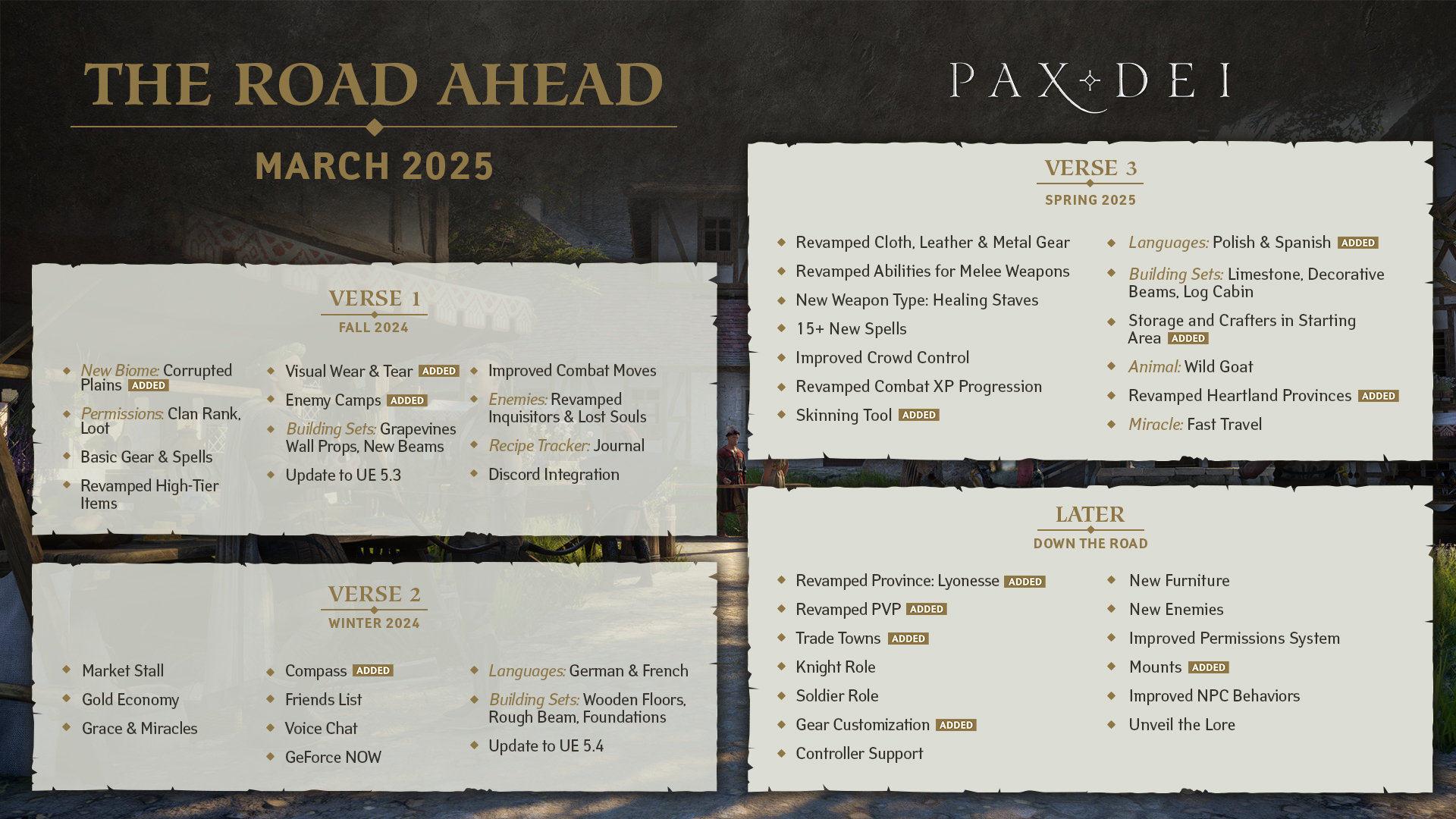
The main goal for us moving into Early Access was to get constant feedback from a live community to help us develop the game. And wow, did the community deliver! We’re grateful for, and humbled by, your continuous engagement. Over 70,000 of you are following Pax Dei’s development journey on our official Discord, and sharing tips and tricks daily to help other players. Looking at the different parts of the game, here is where we stand today. We spent the first months stabilizing the game. Then, our first update, [i][b]Proving Grounds[/b][/i], was about addressing some of the biggest challenges we saw emerging before we could focus on adding new systems to deepen the game with [i][b]Market Square[/b][/i] onwards. We also had to make tough decisions. Some features we initially planned had to be deprioritized as we focused on strengthening the foundations of Pax Dei. While this meant delays in some areas, like the highly expected PvP system or the Knight/Soldier feature, it has also allowed us to deploy some elements sooner than planned in the roadmap — and even to add new elements that will make Pax Dei stronger in the long run.Early game
The first obvious lesson from Early Access was that it took too long to get to the fun at the first contact with the game. Part of [i][b]Proving Grounds[/b][/i] was about addressing this: we placed enemy camps in the Heartland valleys and added basic gear and spells so that players now have the option to go on an adventure within the first few hours of play. The introduction of the Journal, along with an overall balancing pass, also helped make the learning curve for crafting less steep. And talking about adventure, the world revamp also included our first new biome since Alpha, the Corrupted Plains. More recently, the addition of the Compass makes finding your way around the world of Pax Dei more convenient. We’re far from done with this aspect of the game and intend to keep iterating on it in upcoming content updates.Combat
Combat remains a major focus. In [i][b]Proving Grounds[/b][/i], we reworked the animation and player movement systems to improve the sec-to-sec combat experience, making it feel smoother and more responsive, while also laying a stronger foundation for future improvements. We also added new spells, rebalanced gear, and gave the Inquisitors and Lost Souls a full rework. In its current form, however, combat often lacks meaningful decision-making. We aim to move to a state where your gear choices and abilities will shape your tactics, encouraging you to build specialized roles. This will be the central part of our next Verse. Check below for a sneak peek, and we look forward to sharing more soon.Building
Building is undoubtedly the most complete system in the game. We’re amazed at how it unlocks the creativity of the community. Watching the world fill up with beautiful villages, mighty fortresses, and sprawling cities is a constant joy. We’ve been regularly adding new pieces to the game and plan on expanding the building sets to give even more options to our master builders. Yes, the highly expected Limestone should be part of Verse 3! That said, the free-form nature of our building system comes with a number of challenges, notably on the performance side.The valleys with the most spectacular creations tend to be the hardest on framerate. We’ve already rolled out a number of performance improvements — it was one of the underlying reasons for our recent shift to Unreal Engine 5.4 — and more are in the works. Finally, we still have to tackle the “ghost town” syndrome, when the world gradually fills up with the homes of inactive players. Work on a more robust system to clean up plots of inactive players has started — more details will come soon.Building Bridges Between Players
At the heart of any MMO lies one simple truth: connection fuels the experience. That’s why Pax Dei was among the first games to integrate the new [url=https://discord.com/developers/social-sdk]Discord Social SDK[/url]—bringing seamless text chat, friends lists, voice chat, and more into the game. Our goal is to make it easier for players to communicate, coordinate, and share adventures—whether they're crafting in a village or battling side-by-side. And because connection also means speaking your language, Pax Dei is now available in German and French, with Polish and Spanish coming soon.Closing the loop
As a player-driven Social Sandbox MMO, the heart of Pax Dei is very much its economy, thriving not through scripted content but by fostering meaningful social interactions, trade, and competition. If we take a bird’s eye view, Pax Dei relies on one core engagement loop: Harvest, Create, Destroy — a cycle that empowers players to shape the world of Pax Dei. Harvest covers actions like cutting wood, mining, hunting, and ‘farming’ PVE enemies for gold and loot. Create encompasses crafting and building systems. While much work remains, these two parts of the loop are now firmly in place. For the game economy to become self-sustaining on a larger scale—to truly close the loop—we now need to offer players meaningful ways to spend what they earn. In other words, there must be systems that allow value to be removed from the economy, balancing what’s gained through harvesting and crafting. By “value,” we mean your gear, gold, and Grace. Don’t worry—your plots remain safe and will continue to be protected under the Pax Dei. From that perspective, [i][b]Market Square[/b][/i] added two crucial components to the game.- Market Stalls and the Gold economy allow player-to-player trading, which opens ways for players to specialize. If you prefer playing a crafter rather than a fighter, you now have a way to get the components you need from other players — by selling them the equipment they require for the part of the game they prefer to engage with.
- By spending Grace, players can now access effects that will help them progress in the game. We’ve only added a few spells for now, and more are coming. This is one part of the game where we want to give players ample opportunities to feel good about spending some of the value they have accumulated.