Happy Thursday and welcome back to yet another Victoria 3 development diary. A few weeks ago I went over the changes we’re making to Political Movements in update 1.8, and promised a followup going more into how this impacts Civil Wars and particularly Secessions. As you might have guessed by the title, this is precisely what we’ll be discussing today, along with a bit more detail on Political Movement Radicalism, where it comes from, and how it ties into Civil Wars.
As I went over in the aforementioned Dev Diary, Political Movements have a Radicalism value going from 0-100%. More specifically, this is two values: The [b]current[/b] value and the [b]target value[/b], with the current value drifting towards the target value over time. The target value is calculated from a number of factors, including:
Happy Thursday and welcome back to yet another Victoria 3 development diary. A few weeks ago I went over the changes we’re making to Political Movements in update 1.8, and promised a followup going more into how this impacts Civil Wars and particularly Secessions. As you might have guessed by the title, this is precisely what we’ll be discussing today, along with a bit more detail on Political Movement Radicalism, where it comes from, and how it ties into Civil Wars.
As I went over in the aforementioned Dev Diary, Political Movements have a Radicalism value going from 0-100%. More specifically, this is two values: The [b]current[/b] value and the [b]target value[/b], with the current value drifting towards the target value over time. The target value is calculated from a number of factors, including:
- Which laws you have enacted or are in the process of enacting (if the movement’s core ideology has a stance on them)
- How many radicals and loyalists are members of the movement
- Other factors specific to a particular movement type. For example, a Cultural Majority movement might be upset if the ruler of the country isn’t of one of your primary cultures, or a Pro-Slavery movement might be upset if they perceive that Slave States are not receiving their fair share of government building construction, particularly for the army.

 I already went over the different Radicalism thresholds and their effects, so I won’t repeat myself there, but instead focus on the highest radicalism threshold (currently called ‘Rioting’, but we’re probably going to rename it) where Civil Wars become possible. While this isn’t technically all that different from before, what is different is that [b]all civil wars are now started by Radical movements[/b], including Secessions.
What this means is that the previous system we had for Secessions, where they just randomly start when a culture has high turmoil, is completely and utterly gone from the game. Instead, Movements can ignite a Civil War that is either a Revolution [b]or[/b] a Secession. Whether a radical movement starts a Revolution or a Secession depends on the Movement Type and the specific circumstances in your country, so I’ll list a few examples of how we currently envision this to work (the exact details may change before release though):
I already went over the different Radicalism thresholds and their effects, so I won’t repeat myself there, but instead focus on the highest radicalism threshold (currently called ‘Rioting’, but we’re probably going to rename it) where Civil Wars become possible. While this isn’t technically all that different from before, what is different is that [b]all civil wars are now started by Radical movements[/b], including Secessions.
What this means is that the previous system we had for Secessions, where they just randomly start when a culture has high turmoil, is completely and utterly gone from the game. Instead, Movements can ignite a Civil War that is either a Revolution [b]or[/b] a Secession. Whether a radical movement starts a Revolution or a Secession depends on the Movement Type and the specific circumstances in your country, so I’ll list a few examples of how we currently envision this to work (the exact details may change before release though):
- Cultural Minority movements will generally always try to Secede if they can
- Royalist Movements will generally always launch a Revolution if they can, but might Secede under very specific circumstances (see below)
- Pro-Slavery/Anti-Slavery Movements will usually launch Revolutions, but under Legacy Slavery (ie the American Civil War situation) will tend to secede instead
- Religious Minority movement might launch a Revolution to change the State Religion if they have broad enough support, but otherwise would Secede
- The Interest Group must be influenced by the Movement (ie be able to get character ideologies from it)
- The Interest Group must be Angry
- The Interest Group must be at least somewhat ideologically aligned with the Movement (ie, Landowners led by a Slaver wouldn’t join an Abolitionist uprising)
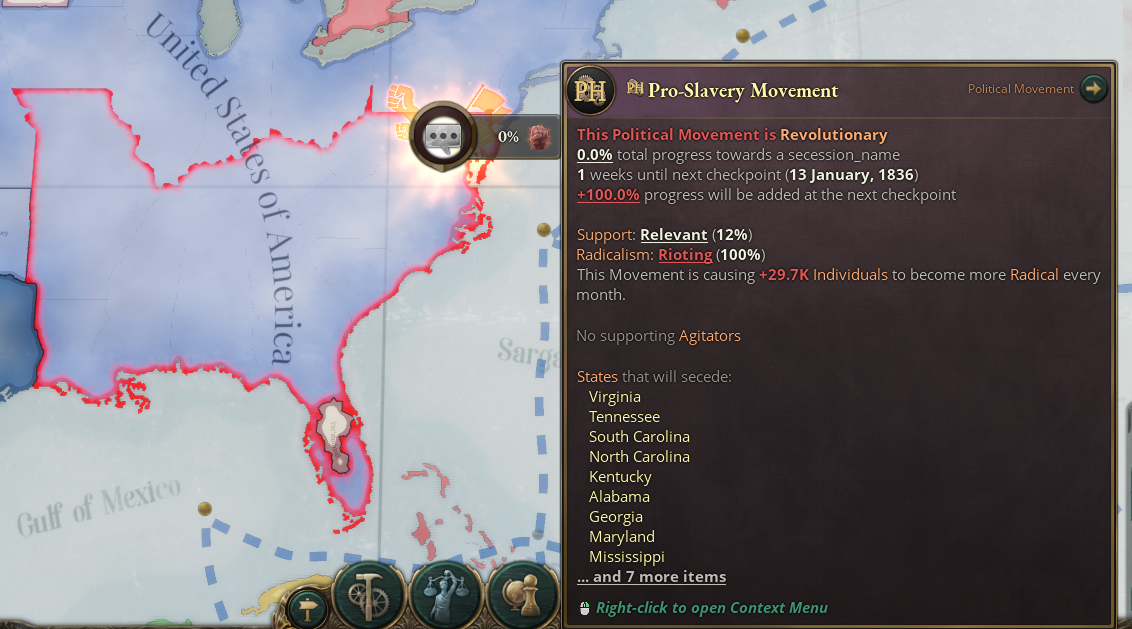 Another part of Civil Wars that has changed considerably is state assignment, ie which precise states rise up against you. Previously, state assignment worked according to a few basic rules:
- For Revolutions, a fraction of states would rise up based on Movement Support (frequently this would be ‘everything but the capital’ if the movement was strong enough)
- For Secessions, a fraction of cultural homelands would rise up based on level of turmoil (usually, all of them)
- For Revolutions, only Incorporated states could rise up
- The Capital could never rise up
 Alright then, that’s all for today, but do join us again next week, when Alex will tell you all about Famines and Harvest Conditions. See you then!